The Smile at the Table


Austin leaned down, his forearms braced on the back of a chair, and hid his face in the crook of his arm for a moment. The pretense was weariness at the beginning of lunch shift, having already had classes that morning. The truth, however, was that he was hiding his expression. He just didn’t have the heart to tell Kayla that their manager had not scheduled her that summer in hopes that she would get frustrated and just quit. The truth was that Kayla sucked at the job; she got orders mixed up, forgot things, took forever, and whined egregiously when customers didn’t tip her well but, rather tipped her what her service was worth. She was nice enough, pleasant, yes, but a poor waitress.

Austin, on the other hand, thrived in high demand work like this. It kept his memory sharp and his charming interpersonal communication skill set evolving. He was handsome enough, this he knew. The phone numbers written on receipts in his ticket folio also attested to this. He kept himself tidy, comfortably stylish, personable. You have to be able to handle people in all facets and situations, and what better proving ground for that than food service? Proving ground and smelting furnace all in one. Especially weekends. But today was Monday. Lunch rush tended to be slower, hence why he could stop and chat right now.

Mondays weren’t so bad.

Flash Fiction: The Despairing Truth


“You must stop this, sir! You mustn’t speak this way!”

The lady’s hand pressed against the bodice of her dress as if to keep her heart from breaking through the cage of her ribs, corset, and stays and bursting right through the delicate silk of her dress. His words shocked and startled her and she struggled to stand her ground.

“Nay, Madame! I must and will speak my mind,” the gentleman insisted.

The lady drew back from him as if in fear. Spoken words were dangerous, as they could not be unsaid. Spoken minds were even worse, as they could be forever remembered.

“I beg you, say no more!” she pled, anger beginning to forment within her at this intrusion to her serenity. “I am a married woman, I remind you.”

“And your husband is a fool to make such a devoted wife penniless after his own foolishness!” he spoke hotly now at her mindless defense of the man all knew to be a thoughtless cad.

Her breath was stolen by that hard-slung word.

“Penniless?” Impossible. “You are mistaken, sir. Utterly mistaken. My family–”

“Has been in debit for months, Madame.” His voice betrayed his sadness as this fact. “Your fortune is in shambles. Your husband has borrowed against promises and his debts are being called in. Even now, the bailiffs are on their way to your residence.”

The warm summer day had turned deathly chill to her and she felt herself grow faint, grasping at the tree under which they stood to keep herself upright. He reached to help her but she held up a trembling hand to ward him off.

“I must get home. The staff will be aghast and my children so frightened. Please, take me home, Stanton, and, as we go, you will tell me all. Do you hear me? All!”

Stanton did as commanded, offering her his arm to lean on. He led her back towards the road, hailed a hansom and, as they drove through the busy morning streets as quickly as may, he detailed Isabelle’s husband’s descent into disgrace, shame, and penury at the gambling tables and moneylender’s counters.

Isabelle’s face grew pale and then stoney as marble by turns as her eyes were opened to the unabashed truth to which only she had been a stranger. “Then we are indeed ruined,” she breathed in horror-stricken resignation, “Utterly ruined.” Not only in lack of money but their respectability – her respectability – was now stricken through in black. Lowell had ruined not only himself but also her, shattered their children’s prospects, and their family name.

She turned her eyes to the man who sat across from her, those eyes made brighter by the tears that filled them, her hands twisted together so tightly as to almost tear her delicate gloves. But she did not cry. Instead, she fixed her face like a flint on this man who claimed to be her friend and asked,

“Stanton, what am I to do?”

The look on his face said all she needed to know.

Memories Trapped in Chestnut


There was a memory trapped somewhere in her hair, a memory she desperately wished she could remember. She knew that it was one she had cherished and replayed with all fondness. Its scent was tangled there in her chestnut tresses, and she caught it when she would tilt her head just so or when the wind would throw her hair about her head like a halo. What was it? A person? A place? Perhaps just a moment in time? Whatever it was, it lingered there, teasing her affectionately and she found herself smiling at every little moment. And that, in itself, was precious.

The Bride in Blue


Author’s Note: This is all my original work and belongs to me, Melissa Snyder. I do not know if I will continue posting updates after this but, again, I would appreciate first impressions/comments/constructive critiques. Thank you!

= = = =

They call her blessed, fortunate, prized among women. They touch her with gentle hands, whisper prayers of blessing, and utter yips of approval. She is set above the salt; she is raised high.

She is to be a bride in blue.

Continue reading

Flash Fiction: The Bride in Blue


They call her blessed, fortunate, prized among women. They touch her with gentle hands, whisper prayers of blessing, and utter yips of approval. She is set above the salt; she is raised high. She is to be a bride in blue.

She is to be a bride in blue.

A bride in blue is special, set apart, set above. She might not be the first wife, the last wife, or even officially a wife. A bride in blue is something completely different. She is not the lady of the family or the head of the household. She could bear children but, often, precautions were taken to prevent the marring of her form. If she does, they will be placed in the nursery and taken to breast and mother by another, that blessed name never reserved for her. She was the height of the social court. When her lord or duke, warden or councillor will give great feasts or celebrations, bedecked and glittering for their distinguished guests, it is his blue bride who will appear at his side, the shining star on his arm. She will reign supreme, the celestial gem seated enthroned in his court for that night. She is the one about whom the minstrels will sing, the poets will write, and to whom men will swear chivalric fealty and their bravery’s blood.

They call her blessed, fortunate, prized among women. They touch her with gentle hands, whisper prayers of blessing, and utter yips of approval as they brush her locks until they gleam, paint her lips an ember red, and drape the sapphire gossamer over her head. Today, she will be a bride. She will be no wife. She will be no mother. Forever, she will be a bride in blue.

= = = =

This piece was inspired by my daughter running around, my dancing veil of filmy blue sari chiffon draped over her head. I’d really like feedback on this one. Please, feel free to leave me your thoughts in the comments. ^_^

NaBloPoMo 2014 Day 28: The Doll Mage


Author’s Note: This character creation story was inspired in part by the novel Dollmage by Martine Leavitt and also in part to the late night idea sessions held with my husband for Changeling: The Lost. He wondered aloud how creepy it would be to have an Elemental Manikin who was also a doll-maker. I insisted that, no, she would have to be an Artist and this character’s story began to unravel itself in my brain. A girl who hated dolls who was fated to make them for all time for a cruel master. Not a bad beginning, hm?

= = =

Delilah had a serious Elektra complex. At least that’s what most psychotherapists would say. She adored her step-father with everything that she had (her own father had died in the war just before she was born). Her step-daddy was perfect. Everything he did was perfect. She loved being with her step-father.

Her mother…was a whole different story. People often said that Delilah looked like her mother but a sour look always came over the girl’s face when someone said that. She didn’t like being compared to her mother. Delilah’s mother was a quiet woman who loved dolls. She even made her own dolls and, for Delilah’s 12th birthday, she made a very special little lady. She even made the doll’s beautiful blond curls herself, painted that perfect bow mouth with her own two hands. She sewed the doll’s beautiful purple dress, fashioned her lace and satin hat. When she brought it out to Delilah at the height of the girl’s birthday party, it all fell apart. Delilah despised the doll that her mother had so painstakingly made, throwing it on the ground and insisting that she wanted a Barbie doll, the new line that had just come out recently.

“Not your stupid, old-fashioned doll!” Delilah threw it down again, and, this time, the doll’s delicate porcelain face shattered into pieces on the tile floor.

The party stopped dead, everyone going silent. Delilah just glared at her mother and, quickly, her father hurried her off to open gifts from the other guests. “Come on, Del, honey. Let’s open your other presents.”

Silently, Delilah’s mother gathered up the remains of the shattered doll, trying to hide her tears as she did. What none of them knew was that another set of eyes was watching them. In the shadows of the room, a Drudgeman watched everything. This particular one was called Grange, and he adored Delilah’s mother. He loved her creativity and had helped her with her dolls many a-time, adding charming little touches when she wasn’t looking. The little things that hardly anyone would notice but everyone could appreciate without even really knowing what all they were appreciating.

But this little girl. This little girl angered Grange. Sharon deserved a much better daughter than this, especially since he knew this girl had doll-talent. She despised the gift her mother had given her – both figuratively and literally – and he just would not let that stand.

Off to Arcadia he went, a plan percolating in his mind. He had promised one of the Fae to keep his eyes out for a child with maker-talent. And this child was perfect, he decided. So off Grange trot and the Fae was quite glad to hear of his discovery; they concocted a plan and contracted it.

It wasn’t too long. One night, in the darkness, Delilah disappeared, leaving something else in her place. Something sweet, loving, and just what Sharon deserved.

~ ~ ~

Meanwhile, Delilah was spirited off into Arcadia, where she kicked and screamed and hollered all the way in Grange’s grip. Used to humans, he didn’t have issue with it but the Fae that he delivered her to found it most annoying. He commanded her to be quiet. Of course, Delilah didn’t. She, in return, demanded that she be allowed to go home to her father. She wanted her daddy!

Finally, the Fae had had enough. Pulling out an ebonite needle and black widow thread, he held Delilah fast and savagely sewed her mouth shut. “Now you will listen, willful sprite. I have brought you here for a reason. You have maker-talent, doll-talent, and you will use it for me.”

A smile split his face then. A smile like the one she had seen in her storybooks, the scary ones. “You don’t understand. Of course you don’t.” He waved his hand, opening a window of sorts. In it, she could see her father and mother together in the living room…with her. Or at least what looked like her. The little girl was cradling a doll just like the one that Sharon had made for her birthday. She actually seemed to like the stupid thing and Sharon was all smiles. Dad was behind a newspaper, glancing at them every now and again with a little smile of his own.

No! That wasn’t her! It wasn’t real! She could see it for what it was. A doll of cobbled together yarn, Caymanite eyes, and a poison ivy smile. It wasn’t real!

“See? You have one. And you will make those…fetches…for others. You are not a toy. You are a tool, a worker, a means to an end. Nothing more. If you do not do what I say, I will kill you, and that thing will stay in your place forever. Do you understand?”

Delilah had to admit that she did not understand. But, honestly, that she didn’t understand really didn’t matter all that much. The Master-Maker took her into a workshop and plunked her down into a chair amidst sundry tools and materials. Delilah looked around helplessly, wringing her hands and her lips working against the painful stitches.

The Master-Maker smiled over her, grasping her hands. His skin singed her, leaving red, swollen marks on her hands. “Oh, you’ll know what to do. You are the daughter of a maker; you have the maker-talent, the doll-talent, in your hands.” The storybook smile split his lips again and, releasing her, he exited the room. Before he shut her away in the dark for no one knew how long, she barely caught sight of Grange the Drudgeman beyond the door. He gave her a triumphant, leering look, wiggling deformed fingers at her before the door slammed to.

~ ~ ~

Over the next forty-four years (at least it was that many in the human world), Delilah worked for the Master-Maker, creating fetches for those mortals that he stole away from the real world and into Arcadia. He was sickeningly right; looking at each helpless person that entered his hold, she knew exactly what to do. Each fetch bore her own special touch. A smear of honey for a smile here. A porcupine’s heart there. Kitten fur for hair on this one. A pug’s tail for a nose on that one.

Delilah began to age as well. But slowly, oh so slowly. To grow three inches took a decade. To age a year felt like a lifetime.

After not too long, the Master-Maker began to bring other Fae to see her handiwork and they marveled over her maker’s-talent. Soon, he began to contract her services out to other True Fae.

Delilah made hundreds, maybe thousands of fetches over the decades. It became rote for her. Her fingers moved and made of their own volition; she hardly had to look at what she was doing. The Master-Maker had long ago taken out her stitches, and she had never screamed again.

Before she had begun working, however, the Master-Maker had contracted someone else to “make her more efficient”. His name was Vincent.

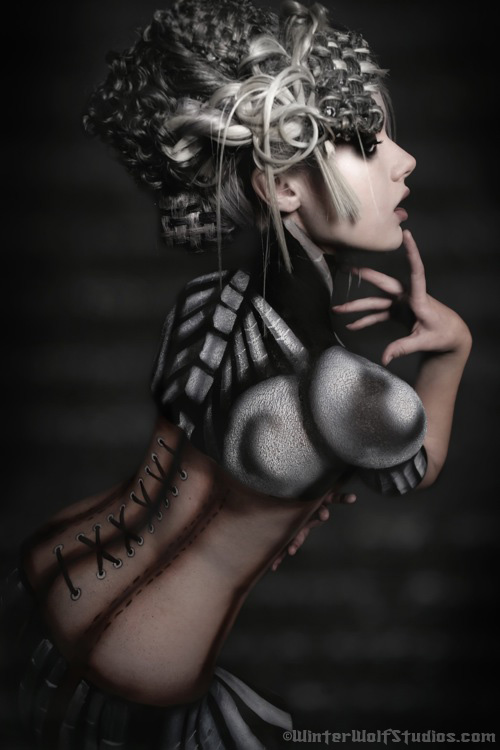
He put corset lacings in her back to make her sit up straight and keep her from becoming bowed from sitting at the workbench. He took away the color in her eyes and made them dark, empty, cold, and capable of absorbing the very soul of person in order to make their fetch. Her skin paled away in the darkness. But Vincent, at the Master-Maker’s command, left the red burns on her hands from his touch to forever mark them. The stitch-scars stayed as well. While she was to become a fetch crafter, Vincent, she discovered, was a crafter of changelings. They worked together several times after that, but she never spoke to him. Nor he to her.

The Master-Maker only came to her when he had a new commission or a new catch for himself. He called her his “maker” or his “tinker”. So that’s what she now calls herself: “Tink Maker”.

~ ~ ~

One night, many years later, a fresh new mortal was brought into Tink’s workshop. She lifted her head from whatever she was working on and cleaned off her workbench silently. The Master-Maker dropped the mortal in front of Tink’s workbench and, as though distracted by something, he turned for the door. Tink raised her head; he’d never left her alone with one of them before.

“This one’s owner is being fractious about the cost. I shall return shortly.”

He slammed the door to behind him and Tink took her long, black, soulless look at the new mortal. Not really seeing them so much as feeling them, sensing them out, after forty-some years. Finally, silently, Tink turned towards her supply cabinet, pulling things out to make this one’s fetch.

“What are you doing?” came a trembling female voice. The mortal.

Tink didn’t reply, only brought the supplies to her bench and began to work silently.

“How can you work for them? How can you do this?” The scared voice turned accusatory. Silence fell again. The mortal tried another tack. “You…you used to be human, didn’t you? Didn’t you?”

Tink didn’t answer. She never answered. She just worked. It kept her safe. It kept her from getting her mouth sewn shut again.

“Please! Please, let me go! I want to go home. I have a husband, a daughter…please! I want to go home. I want to run in the woods with my daughter, walk on the beach with my husband. Don’t you remember? Don’t you remember what it was like? To see the sun, feel its warmth? It’s so cold here.”

Tink struggled to keep her eyes on her work but found them trailing up to look at the woman. She almost gasped. This time, she saw her. Actually saw her. And the woman looked like…like her mother. Same silky gold hair, same big blue eyes – now swimming with tears.

“Please! I have a little girl. A gorgeous little girl. She loves dolls; I have to make her a new one for her birthday.”

Mama! Tink looked down at her hands in horror at the half-finished fetch on her bench. Hay for hair, a porcelain heart, robin’s blood for the mouth. She’d been making her own mother’s fetch!

With a cry, Tink stood and dashed the half-made fetch to the floor! Tears began to stream from her eyes. Her own mother! Turning to the frightened woman, she approached her, hand out.

But the woman’s look turned frantic as she fully saw the black, empty eyes and the stitch-scarred face. “No! Stay away from me!” she cried, afraid that the creature was just about to tear her apart as well. Still Tink reached for her.

She had so much to tell her. That she was sorry, that she loved her, that she missed them both. All of a sudden, the door slammed open and the terrifying face of the Master-Maker stared down at her! His quick eyes took in her closeness to the mortal as well as the ruined fetch on the floor.

“What are you doing? Why aren’t you finished yet?” he demanded.

Tink shook her head. “You can’t have her! Take her back! I won’t…I won’t make her replacement!” Her voice felt heavy, gravelly after not being used for so long. “I won’t let you take my mother!”

Tears streamed down the woman’s face and the Master-Maker’s own split into that storybook villain smile. “Your mother? Oh, my dear little tinker, no. This isn’t your mother.” He yanked the woman to her feet. “This, my little maker, is your sister. She is the spitting image of your mother, though, isn’t she?”

Then his face fell, darkened, became terrifying once more. “Do you have any idea what your stupidity has cost me? Finish it or you will find yourself, and her, in most dire straits. Servants can be replaced, after all!” With that, he yanked the woman away, through the door, slamming it to before Tink could get near it.

“No! Let her go! Let her go! Please! Don’t hurt her! Sister! Sister!” Tink screamed until her voice was raw and banged on the door until her hands bled. But there was no answer but the woman’s screams. They were changing her, transforming her, just like they had done to Tink.

Suddenly, the slot in the door opened. “Hear that, my little tinker?” the Master-Maker asked, as a particularly painful scream rippled through the halls. “Every moment you dally, the worse it becomes for her. Her pain is on your plate. Enjoy it.” The slot slammed shut.

Tink didn’t have a choice. The longer she refused, the harder they would make sure the transformation was for her sister. Falling into silence again, she stooped to gather up the remains of the fetch, sat at the workbench again and, amidst streaming tears, she let her fingers work.

As soon as she put the finishing touches on the fetch, the door opened again and in swept the Master-Maker. He said not a word to Tink but grabbed up the fetch doll and exited the room once more.

Tink felt a great weight settle on her shoulders and she fell forward onto her workbench and sobbed and sobbed.

After that, Tink’s talent began to wane, become shoddy and lackluster. The Master-Maker was displeased, to say the least. His reputation was suffering because of her worsening work. He sewed her mouth shut again when she verbally refused, burned her hands again when she physically refused.

It went on and on. When her work was less than desired, the Master-Maker punished her for the fall in his reputation. Day after day Tink lay in the dark, unsure of whether or not she would survive her next punishment. He was becoming more and more savage when he punished her and she was becoming more and more reckless in her refusals. The stitches had stayed in this time, the burns making her hands ache.

Tink does not know to this day exactly how she escaped. All she can remember is that a mortal lost their life in the process as she fled the Master-Maker’s mansion. And she…she somehow tumbled out of the hedge, scarred, scratched, bleeding, mouth still stitched, into the wilds of Nowhere, Indiana.

Now her story starts all over again.

NaBloPoMo 2014 Day 21: How Things Are Below


There were rules here, a way that things went. Every child born knew the rules from their swaddling. The rules never changed.

1. Finders = keepers.

2. If more than one find it together, it’s divided equally.

3. No hunting until you are sixteen.

4. No stealing! Stealing is the worst sin of all. It could get you killed.

This was how it had always been done and how it would always be done. Learning patience, cunning, and all the necessary skills for hunting took time and practice. But, eventually, you would get to be out there, hunting for your own. You ate what you caught. You kept what you found. You lived each day until you died.

NaBloPoMo 2014 Day 19: Black and Cream


Trigger warning: Loss of loved ones.


She stretched out her hand and ran it over the pillow next to her. It was cold and smooth, memory foam with no memory. It even smelled cold now. Padding from the silent bedroom and into the empty living room, the scent that greeted her made her stop in her tracks. Sometime in the night, the automatic plug-in air freshener must have switched over to a new cartridge and this one drew tears to her eyes.

The creamy, custardy scent filled her nostrils and the synapses in her brain fired, memories pulled to the forefront. Memories of Thanksgivings and Christmases, memories of him cooking and baking and their house filled with heaven for the tongue. His cooking ushered in warmth and laughter and family and fellowship and love. But it was the scent that clung to him that she remembered the most – creamy and sweet, like caramel. He smelled like it for an entire day afterward. In fact, she had started asking him to wait to shower until the next night after cooking such a meal, because she loved him covered in that sweet scent. She would bury her face in his black hair and breathe it in when he held her, taste it on his lips when she kissed him. As they made love and reveled in each other, it came to cover her, too, and, in the morning, her skin smelled (and tasted, so he said) like butter cream.

And now…the living room – this empty room, this cold room, this decoration-less room that radiated alone –  also radiated this scent. A scent that made her crumple to the floor as if the life had been stolen from her alone with her breath. Her home was dark, her life was dark, like a candle suddenly snuffed. With his dark hair and bright eyes and winsome smile, he had been her light, been the warmth of their home. And now he was gone.

Propped against the wall, she sobbed until she feared that, like Alice, she would float away in a sea of her own tears. But those limpid eyes had only one focus for their weeping. And it laid in the stately marble urn that stood upon the mantelpiece of a dark and cold fireplace.

Inspired by “Black is the Color of my True Love’s Hair” as sung by Peter Hollens and Avi Kaplan

NaBloPoMo 2014 Day 13: Corner Table


‘Why do so many stock photos of girls in coffee shops have them sitting with their chin in their hands, looking dreamy or wistful or even morose?’

It was a brief wondering that flit through her head as she sat in – what else? – a coffee shop. It was a warm respite from the world that blustered and blew outside. Her book sat splayed on the table, held down by her left hand as her fingers surround and drum softly on the saucer of her cup of smooth vanilla chai. The steam curls cunningly from the cup, just as the words of the story coil their way into her brain, filling it with characters that she was, admittedly, quickly falling in love with. She cut a rather lovely figure sitting there at her table, in her boots, stockings, skirt, and sweater, her body angled out to allow her to cross her legs. Suddenly, there was a bump against her ankle that drew her out of her world with a start!

“I am so sorry!” came a voice. Unfamiliar, male, but unmistakably apologetic. “Really, I am so very sorry!”

She looked up to find a pair of bright eyes and apologetic smile meeting her own brown-eyed gaze. He bent then to retrieve the offending culprit: a streusel muffin, now more the worse for wear. “Alas, poor Yorick…” the young man intoned, holding up the crumbly confection before depositing it on his plate. “Apologies, I didn’t mean to dive-bomb you with my snack.”

She found herself smiling without reservation, bending down to brush off her ankle with a chuckle. “No, no. It’s all right. I’m just sorry that your muffin didn’t make it.”

“Probably for the best,” he replied, poking the bygone muffin with a quirk of his mouth. He then glanced at the book, which had fallen closed on her tabletop. “Lackey. Is that her new one?” he then asks.

“Oh, yes. One of them. I haven’t gotten Blood Red yet,” she replied with a smile, “Are you a fan of the Elemental Masters?”

“I’ve read a few, yes,” he replies. Then, as if suddenly remembering that he was standing, he indicated the seat across from her, “Excuse me, may I?”

She nodded in acquiescence and he seated himself, introductions made all round and nicely. They fell into conversation as naturally as tripping on the sidewalk, and it soon spanned a myriad of topics and a plethora of stories.

Dark was starting to fall, the lights on the street outside blinking into being and the building windows starting to glow.

“I should go,” she said, reluctance lacing her voice.

He didn’t try to stay her but they said their goodbyes nicely, shaking hands all round. Then he handed her back her book, which he had borrowed from her for a moment.

“I’ll have to thank that muffin for its uneven bottom and well-time dive,” he said, giving her that smile again, “It was a pleasure to meet you.”

“It was a pleasure to meet you, too,” she replied, settling her creamy-colored hat over her dark hair.

He helped her on with her coat, held the door for her, wished her well, and then she stepped out once more into the cold. Her book was cradled under her arm, her hands tucked tightly into her pockets. Little did she know the book was carrying a brand new bookmark within its pages: a simple napkin pressed privately into service, waiting to be found twenty pages onward.

NaBloPoMo 2014 Day 11: The Shadow In My Window


“Once Upon a Time” Peter Pan Art by and Property of Lehanan – http://lehanan.deviantart.com/

Inspired by and based on J.M. Barrie’s creation Peter Pan and Wendy.

= = =

When that shadow showed up at my window, I knew instantly what it was. Part of me didn’t want to let it in, but how can you keep a shadow out? I knew what it heralded. I knew who was coming. And what he was coming for. He was coming for me.

I had done something very foolish. No, very stupid. Everyone with a mind knew that a story wasn’t just a story. There was always something behind those fictions, something real. And he was. He was real. Pan. Barrie had conveniently left out the part about Pan also being an ancient Greek god, represented as a man, forever young, tripping and traipsing and stealing away young women for his enjoyment. I didn’t find that out until later, until after I had done my something stupid.

I had called him. I offered him my voice, since he couldn’t hear mermaids sing or fairies talk. I offered him my breaths to count by, as his days are but one endless summer. I offered him my memories to tell him endless stories. I offered him my heart since he doesn’t know love.

I had offered my life, myself, not to an ageless child bent on fun, but to the god of eternal summer. Peter Pan. Puck. Robin Goodfellow. I had given myself to the oldest of the Old Ones. And now he came to collect. I was to turn sixteen the next day. Age of consent. The beginning of adulthood. And, tonight, his shadow showed up at my window, slipped beneath the brace, and sat itself at the foot of my bed. Its master was soon to follow, stepping through a window that opened to admit him as if glad to see him arrive.

I could smell sunshine in his wake, leaves and salt spray on the wind that brought him to my room. He crouched there on the windowsill. He had eyes like flint, a mouth set in a line that would make even a smile look grim.

And, eventually, he did smile with hand outstretched, a voice lilting yet ancient. “Are you ready to fly? Just think a little happy thought and it will be over quick as winking.”

The shadow loomed and I felt cold. All I could do was stare past him to those stars, just as cold but ever bright. Second to the right and straight on to the light.